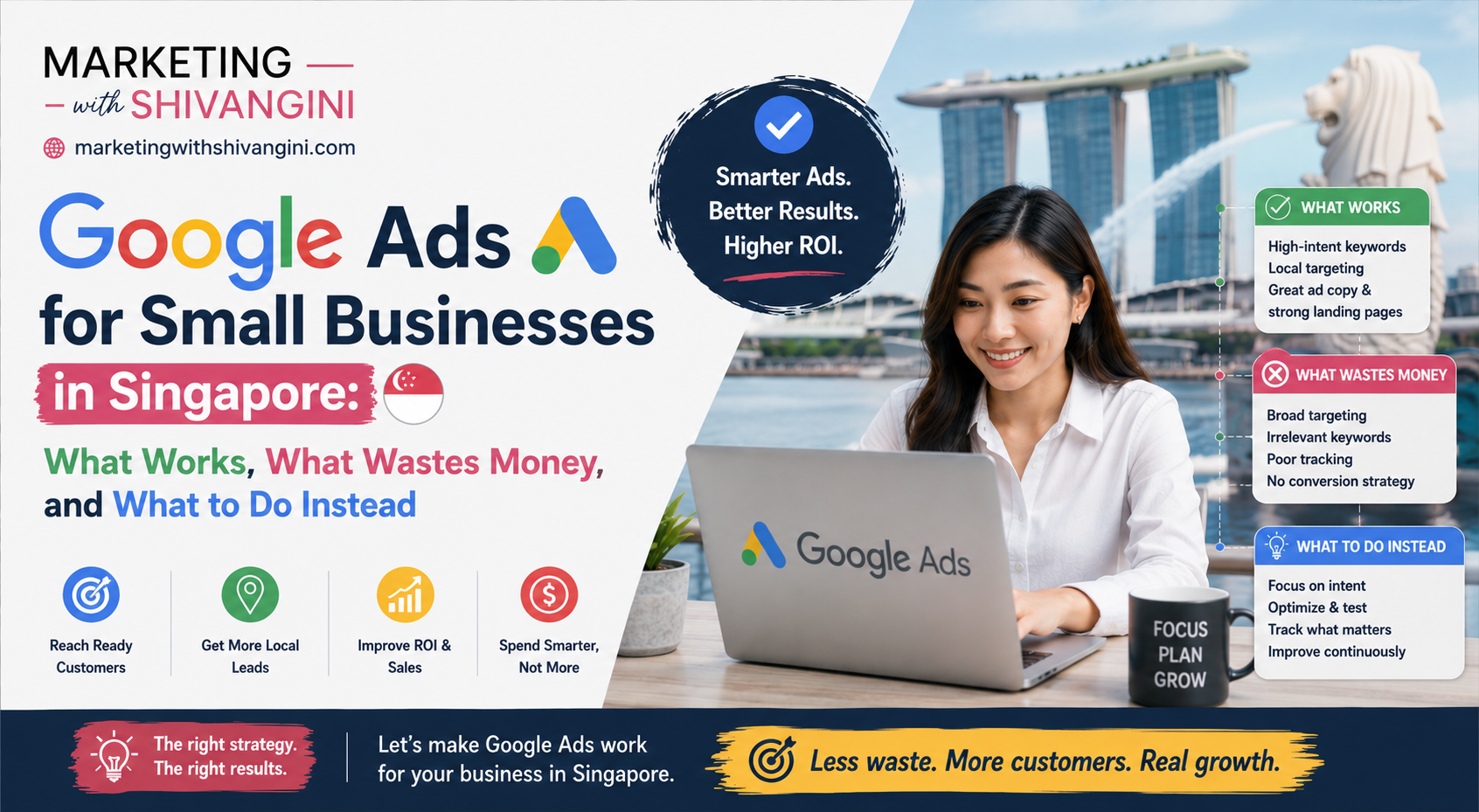
Google Ads for Small Businesses in Singapore: What Works, What Wastes Money, and What to Do Instead
Google Ads can be one of the highest-ROI channels available to a small business in Singapore. It can also be a money pit that drains your marketing budget with nothing to show for it. The difference almost always comes down to setup, structure, and intent matching.
Let me break down what actually drives results in 2026.
Why Google Ads Work Differently From Meta Ads
Meta ads interrupt. Google Search ads intercept. When someone types “physiotherapist for knee pain Tampines” into Google, they already have the problem, they already want help, and they are already in buying mode. A well-placed search ad captures that intent at exactly the right moment. This is why service-based businesses — dentists, lawyers, contractors, tutors, consultants — often see strong performance from Google Search campaigns even with modest budgets.
The Biggest Mistakes Singapore Small Businesses Make
Broad match keywords with no negative keywords. If you sell interior design services in Singapore and run a broad keyword like “interior design,” your ad might show for “interior design courses,” “interior design ideas for free,” and other irrelevant searches. You pay for clicks that will never convert. Negative keywords are not optional — they are essential.
No conversion tracking. If you do not know which keywords and ads are generating leads, you are flying blind. Google Tag Manager and GA4 integration take an afternoon to set up and will save you significant money over time.
Sending traffic to the homepage. This applies to Google Ads just as much as Meta. Match the landing page to the ad. Specific promise, specific page, specific call to action.
Performance Max: Use With Caution
Google’s Performance Max (PMax) campaigns run across Search, Display, YouTube, Gmail, and Maps simultaneously. For large accounts with strong creative assets and conversion data, PMax can be effective. For small businesses just starting out, it can burn through budget across formats where you have no ability to control placement. Start with standard Search campaigns first, build your conversion data, then consider PMax once you have 30 to 50 conversions per month to inform the algorithm.
A Realistic Budget Expectation
In competitive Singapore categories — legal, medical, property, education — cost-per-click can range from SGD 3 to SGD 20 or more. In less competitive niches — beauty, renovation, F&B services — you can see strong results from SGD 20 to 30 per day. Always calculate your target cost per lead before you start, so you know when a campaign is performing and when it is not.
When Google Ads and SEO Work Together
The strongest digital marketing results come from running Google Ads alongside an active SEO strategy. Ads give you immediate visibility while SEO builds your long-term organic presence. Once your SEO starts driving consistent traffic for a keyword, you can reduce ad spend on it and redirect budget to keywords where you have not yet achieved organic rankings.
Book a free Google Ads consultation with Marketing With Shivangini.
Frequently Asked Questions
Q: How much do Google Ads cost for small businesses in Singapore?
Cost-per-click varies significantly by industry. Competitive categories such as legal, medical, property, and education can range from SGD 3 to SGD 20 or more per click. Less competitive niches such as beauty, home renovation, and local F&B services typically see lower CPCs. A daily budget of SGD 20 to 50 is a reasonable starting point for most Singapore small businesses, with results improving as conversion data accumulates.
Q: What are negative keywords and why do they matter in Google Ads?
Negative keywords are search terms you specifically exclude from triggering your ads. Without them, your ads may show for irrelevant searches and waste budget on clicks that will never convert. For example, a renovation contractor should add negatives like “DIY,” “free,” and “course” to avoid paying for traffic from people looking for tutorials rather than professional services. Building a negative keyword list is one of the highest-impact optimisations for any Google Ads account.
Q: Should Singapore small businesses use Performance Max (PMax) campaigns?
Performance Max campaigns run across all Google surfaces simultaneously and can be effective for businesses with strong creative assets and 30 to 50 monthly conversions already recorded. For small businesses just starting out, standard Search campaigns offer more control and clearer data. Start with Search, build your conversion history, then consider PMax once the algorithm has sufficient data to optimise effectively.
Q: What is conversion tracking and why is it essential for Google Ads?
Conversion tracking records what happens after someone clicks your ad — whether they submitted a form, called your number, or completed a purchase. Without it, you cannot tell which keywords and ads are generating real business results. Setting up conversion tracking via Google Tag Manager and GA4 is a non-negotiable step before spending any meaningful budget on Google Ads.