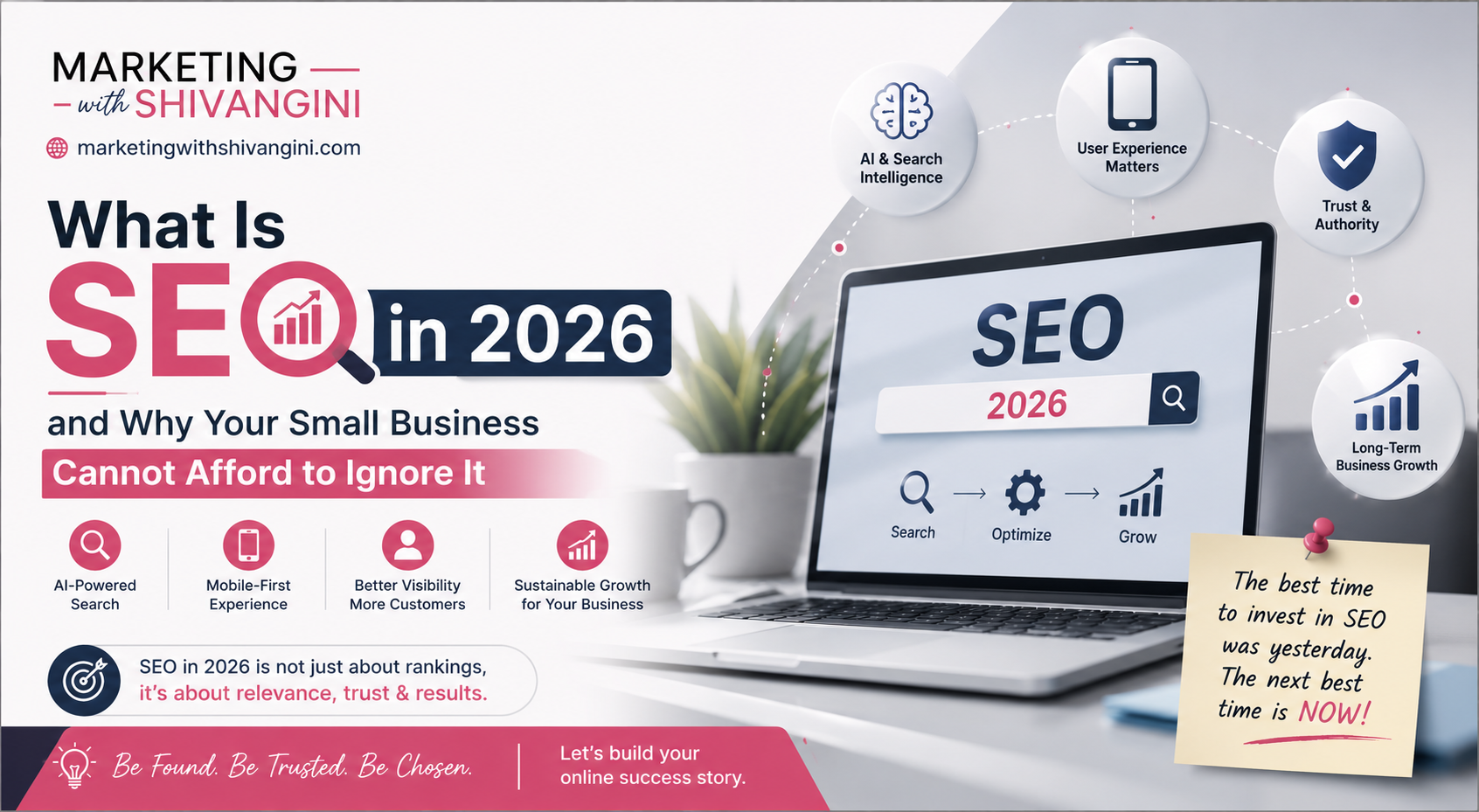
What Is SEO in 2026 and Why Your Small Business Cannot Afford to Ignore It
Ask most small business owners about SEO and you will get one of two answers. Either “we tried it once and it did not work” or “we know we should be doing it but have not got around to it.” Both responses usually mean the same thing: the business is missing out on free, qualified, high-intent traffic every single day.
But here is what makes 2026 a genuinely important year to pay attention: SEO has expanded. It is no longer just about ranking on Google’s blue links. It is about showing up in AI-generated answers on ChatGPT, Gemini, Perplexity, and Claude — the platforms your potential customers are increasingly turning to when they have a question.
What SEO Actually Means Today
Traditional SEO was about keywords, backlinks, and page structure. All of that still matters. But in 2026, there are two additional layers every business needs to understand.
AEO — Answer Engine Optimisation is about structuring your content so AI platforms can pull from it when answering user questions. If someone asks ChatGPT “who is the best digital marketing consultant in Singapore for small businesses,” your content needs to be structured, authoritative, and specific enough to be quoted or referenced.
GEO — Generative Engine Optimisation is about making your brand visible in AI-generated summaries. This is about being cited, not just ranked. The way to achieve it is through clear writing, structured FAQs on your website, specific and credible claims, and consistent brand mentions across the web.
Why This Matters for Singapore Small Businesses
Singapore has one of the highest AI adoption rates in Southeast Asia. Your customers are already asking AI assistants for recommendations. If your business does not appear in those answers, your competitor’s does.
Local SEO remains powerful too. Google Maps searches, “near me” queries, and voice search are still dominated by well-optimised local listings. A physio clinic, beauty salon, or interior design firm that owns its local SEO has a significant advantage over everyone who has not bothered.
The Practical Starting Point
Three things to do this month. First, audit your existing content and add a structured FAQ section to your key service pages — AI platforms love directly answerable content. Second, make sure your business is cited correctly and consistently across Google, Yelp, Facebook, and relevant local directories. Third, start publishing long-form, specific content that answers the questions your ideal clients are already asking.
SEO takes time, but it compounds. Every piece of well-optimised content is an asset that keeps working for you around the clock.
Want to know how your website currently performs? Get a free SEO audit from Marketing With Shivangini.
Frequently Asked Questions
Q: What is SEO and why does it matter for small businesses in Singapore in 2026?
SEO (Search Engine Optimisation) is the process of making your website appear in search results when potential clients look for services you offer. In 2026, it has expanded beyond Google to include AI platforms like ChatGPT, Gemini, and Claude, which now answer questions directly. If your business is not optimised for these platforms, you are invisible to a growing share of your potential market.
Q: What is the difference between AEO and GEO in SEO?
AEO stands for Answer Engine Optimisation — structuring your content so AI platforms can pull from it when answering user questions. GEO stands for Generative Engine Optimisation — making your brand appear in AI-generated summaries and citations. Both require clear, authoritative, well-structured content. Adding FAQ sections and specific answers to client questions on your website is one of the most effective ways to achieve both.
Q: How long does SEO take to work for a Singapore small business?
Typically three to six months to see meaningful movement in rankings, and six to twelve months to build significant organic traffic. Local SEO — optimising your Google Business Profile and local directory listings — can produce results faster, sometimes within four to eight weeks. The key is consistency: SEO is not a one-time task but an ongoing process.
Q: Is SEO still worth investing in when paid ads can generate leads immediately?
Yes, and the two work best together. Paid ads deliver immediate visibility but stop the moment you stop spending. SEO builds an asset — your website’s authority — that continues to generate traffic without ongoing ad spend. Businesses that invest in both enjoy a significant long-term cost-per-lead advantage over those relying solely on paid channels.