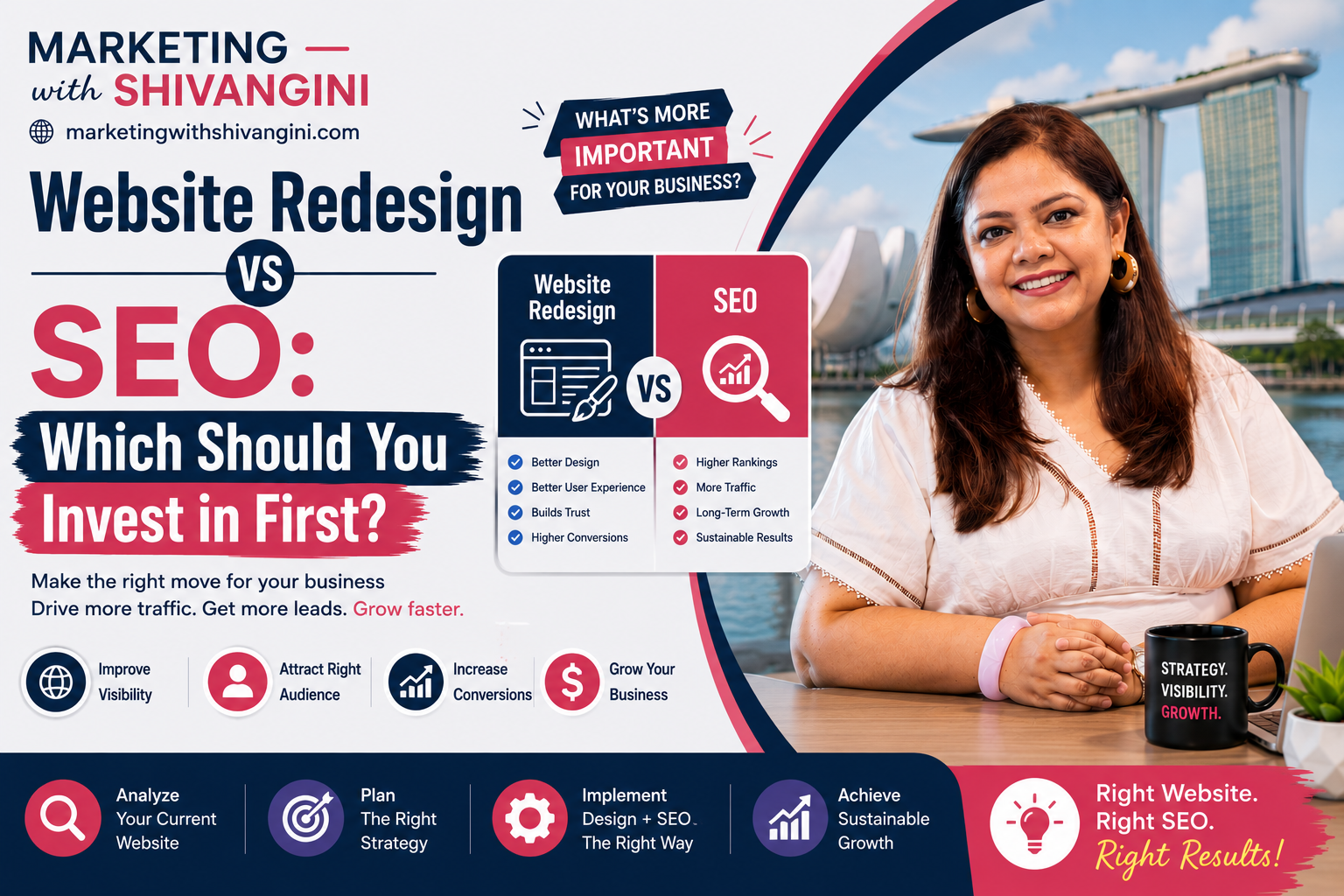
Website Redesign vs SEO: Which Should You Invest in First?
A common question among Singapore business owners is: Should I redesign my website first or invest in SEO? If your website isn’t generating leads or ranking on Google, it can be tempting to start from scratch with a new design. However, a redesign alone won’t guarantee more traffic or better conversions.
The right choice depends on your website’s current condition, business goals, and budget.
In this guide, we’ll compare website redesign vs SEO, explain when each makes sense, and help you decide where to invest first.
Understanding the Difference
What is a Website Redesign?
A website redesign focuses on improving the look, functionality, and user experience of your website. It may include:
- New layout and branding
- Faster loading speed
- Mobile responsiveness
- Better navigation
- Updated content
- Improved user experience (UX)
- New features and integrations
The goal is to create a website that is modern, user-friendly, and conversion-focused.
What is SEO?
Search Engine Optimization (SEO) helps your website rank higher on Google and other search engines. It involves:
- Keyword research
- On-page optimization
- Technical SEO
- Content creation
- Link building
- Local SEO
- Website performance improvements
The goal is to attract organic traffic and generate qualified leads without paying for every click.
When Should You Invest in a Website Redesign?
A redesign should be your priority if your website has major usability or technical issues.
Signs You Need a Website Redesign
- Your website looks outdated.
- It isn’t mobile-friendly.
- Pages load slowly.
- Navigation is confusing.
- Visitors leave quickly (high bounce rate).
- Contact forms don’t work properly.
- Your branding has changed.
- The website isn’t secure (HTTPS).
- It doesn’t reflect your current services.
A modern website builds trust and improves user experience, making it easier for visitors to convert into customers.
When Should You Invest in SEO?
If your website already looks professional and functions well but isn’t attracting visitors, SEO should come first.
Signs You Need SEO
- Your website isn’t ranking on Google.
- Organic traffic is low.
- Competitors outrank you.
- You receive very few enquiries from your website.
- You haven’t published blog content.
- Your pages aren’t optimized for keywords.
- Your Google Business Profile isn’t optimized.
SEO helps potential customers find your business when they’re actively searching for your products or services.
Website Redesign vs SEO Comparison
| Feature | Website Redesign | SEO |
|---|---|---|
| Improves Appearance | ✅ | ❌ |
| Improves Google Rankings | ⚠️ Indirectly | ✅ |
| Generates Organic Traffic | ❌ | ✅ |
| Improves User Experience | ✅ | ✅ |
| Increases Leads | ✅ (if optimized) | ✅ |
| Long-Term Investment | ✅ | ✅ |
| Requires Ongoing Work | Occasional | Continuous |
Why SEO Without a Good Website Doesn’t Work
Imagine your website ranks #1 on Google, but visitors find:
- Slow loading pages
- Outdated design
- Broken links
- Poor mobile experience
- Difficult navigation
They’ll likely leave without contacting you.
High rankings alone don’t guarantee conversions.
Why a Beautiful Website Without SEO Doesn’t Work
On the other hand, you may have an attractive website, but if nobody can find it on Google, it won’t generate business.
A well-designed website without SEO is like opening a beautiful shop on a street where no one passes by.
The Best Strategy: Combine Website Redesign and SEO
Rather than choosing one over the other, successful businesses integrate SEO into the redesign process.
During the Redesign
- Optimize website structure.
- Improve page speed.
- Create SEO-friendly URLs.
- Add schema markup.
- Optimize images.
- Build a mobile-responsive design.
- Improve internal linking.
- Include clear calls-to-action.
This prevents ranking losses and creates a stronger foundation for long-term growth.
Cost Considerations
Website Redesign
Typically involves a one-time investment covering:
- Design
- Development
- Content updates
- Testing
- Launch
SEO
Usually requires an ongoing monthly investment for:
- Content creation
- Technical optimization
- Keyword tracking
- Backlink building
- Performance monitoring
- Local SEO
Businesses often achieve the best ROI by investing in both over time.
Common Mistakes to Avoid
- Redesigning a website without preserving existing SEO rankings.
- Changing URLs without implementing proper redirects.
- Ignoring keyword research during the redesign.
- Choosing design over website speed.
- Publishing duplicate or thin content.
- Forgetting to optimize for mobile users.
- Not tracking performance with Google Analytics and Google Search Console.
How to Decide
Choose a Website Redesign First If:
- Your website is more than 5 years old.
- It’s not mobile-friendly.
- It loads slowly.
- Your branding has changed.
- User experience is poor.
- Visitors aren’t converting.
Choose SEO First If:
- Your website already looks modern.
- It loads quickly.
- User experience is good.
- You’re simply not getting enough traffic.
- Your competitors rank above you.
- You want long-term organic growth.
Final Verdict
For most Singapore SMEs, SEO should be integrated into every website redesign—not treated as a separate project.
If your website has major design or technical issues, redesign it first while building SEO into the process. If your website is already modern and user-friendly, prioritize SEO to increase visibility and attract qualified traffic.
The most successful businesses don’t choose between website redesign and SEO—they invest in both, ensuring their website not only looks professional but also ranks well and converts visitors into customers.
If you’re looking to improve your online presence, Marketing With Shivangini helps Singapore businesses combine modern website design with data-driven SEO strategies to drive sustainable traffic, leads, and business growth.
Frequently Asked Questions (FAQs)
1. Should I redesign my website before starting SEO?
If your website is outdated, slow, or difficult to use, a redesign is recommended. Make sure SEO is included during the redesign process to protect and improve your search rankings.
2. Can SEO improve an old website?
Yes. SEO can improve visibility and traffic, but if the website has poor performance or user experience, redesigning it may produce better long-term results.
3. Will redesigning my website improve Google rankings?
Not automatically. Rankings improve when the redesign includes SEO best practices such as optimized content, technical SEO, mobile responsiveness, and faster page speeds.
4. How often should a business redesign its website?
Most businesses should review their website every 3–5 years, or sooner if branding, technology, or customer expectations change significantly.
5. Is SEO more cost-effective than a website redesign?
SEO often provides a stronger long-term return because it generates ongoing organic traffic, while a redesign is typically a one-time investment focused on user experience.
6. Can I redesign my website without losing SEO rankings?
Yes. By preserving URLs where possible, using proper 301 redirects, maintaining optimized content, and monitoring performance during the transition, ranking losses can be minimized.
7. What’s the ideal approach for Singapore SMEs?
The best approach is to build an SEO-friendly website from the start and continue investing in SEO after launch to attract traffic, generate leads, and support long-term growth.