



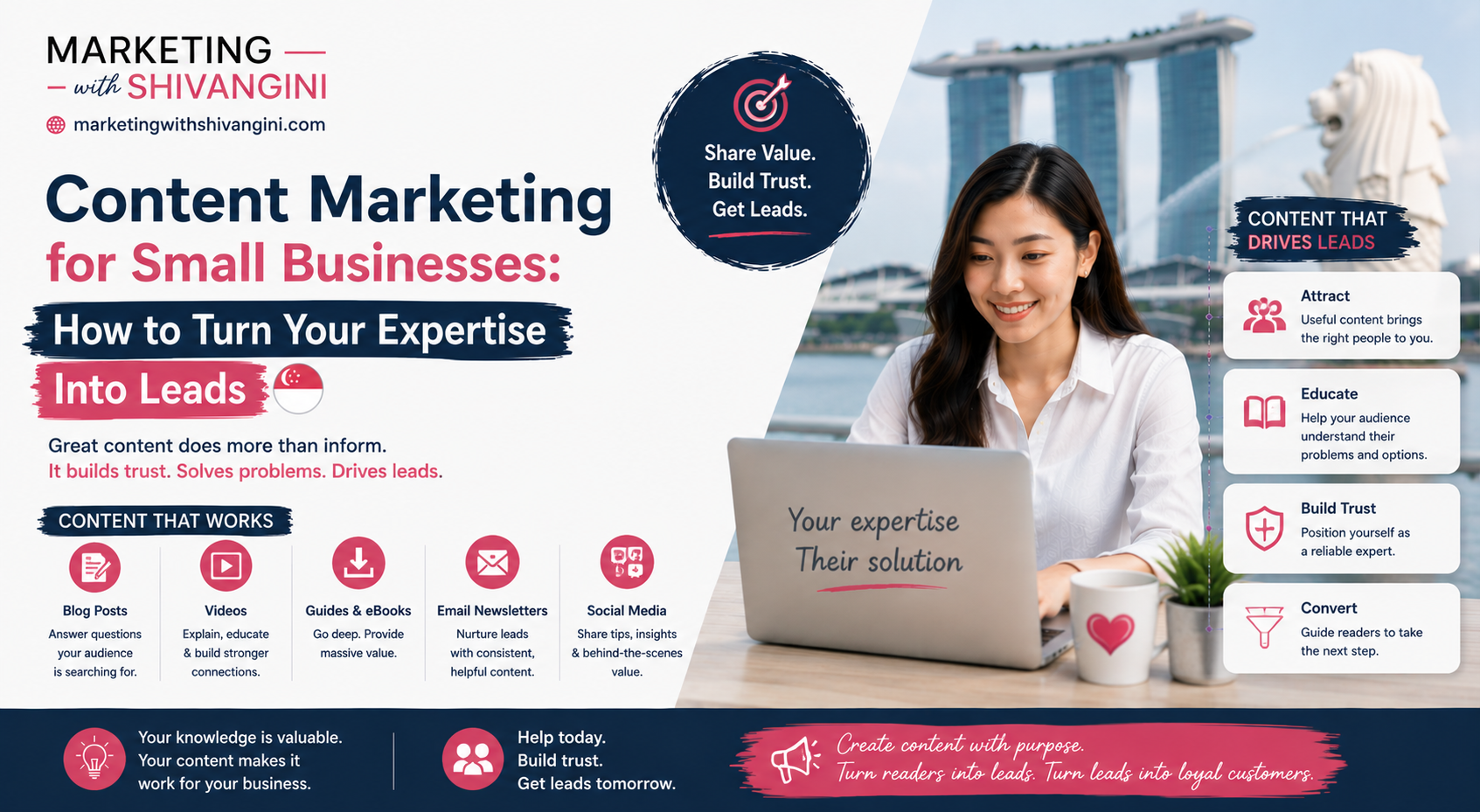
Content Marketing for Small Businesses: How to Turn Your Expertise Into Leads
Every small business owner I have worked with has expertise that their ideal clients would pay to access. The doctor who can explain health conditions in plain language. The lawyer who can demystify a contract. The interior designer who can help a homeowner avoid costly renovation mistakes. The financial adviser who can cut through the jargon.
Content marketing is simply the act of making that expertise visible and accessible before someone becomes a client. It is one of the most powerful lead generation tools available to small businesses — and it is often the most underestimated.
Why Most Small Business Content Does Not Work
The failure mode is always the same: content that talks about the business rather than the client’s problem. “We are proud to announce…” posts. Generic tips lifted from other websites. Service descriptions dressed up as articles.
Clients are not looking for that. They are looking for answers. They have a specific problem, a specific question, a specific fear — and they are searching for someone who understands it well enough to help them. Content that addresses those specific questions is what ranks on Google, gets shared on social media, and is increasingly what gets cited by AI platforms.
A Framework That Actually Works
Step one: List the 10 questions your ideal clients ask most often. Not general industry questions — the specific questions your clients ask you, your receptionist, or your sales team. These are your content topics.
Step two: Write one piece of content per question. Each piece should be 600 to 1,200 words, structured with clear headings, and written in a voice that matches how you talk when you are explaining something to a client face to face. Not academic. Not corporate. Human.
Step three: Publish on your blog, repurpose on social. The blog post is the anchor. The social media post drives people to it. The short-form video summarises it. One piece of content, three or four formats.
Step four: Add a relevant call to action to every piece. Content that does not lead anywhere is a missed opportunity. Every blog post should end with an invitation to contact you, book a consultation, or download a resource.
The SEO Benefit You Cannot Afford to Ignore
Well-structured content on a topic your clients search for will appear in Google search results, Google’s AI Overviews, and increasingly in answers from ChatGPT, Claude, and Gemini. In 2026, the authority signals that AI platforms use to decide who to cite include: clarity of writing, specificity of information, consistency of publishing, and credibility signals like reviews and mentions on other sites.
Publishing consistently — even once a week — compounds over time in ways that paid advertising cannot replicate.
[We create SEO-driven blog content for Singapore small businesses. See our content marketing services.
Frequently Asked Questions
Q: What is content marketing and how does it generate leads for small businesses?
Content marketing is the practice of publishing useful, relevant information — blogs, videos, social posts, guides — that attracts your ideal clients by answering the questions they are already searching for. Rather than interrupting people with ads, content marketing positions you as the expert they find when they go looking for help. Over time, this builds authority, drives organic search traffic, and generates inbound enquiries from people already pre-qualified by the content they read.
Q: How long should a blog post be for a Singapore small business website?
For SEO purposes, aim for 600 to 1,500 words per post. Shorter posts can rank for specific questions but lack the depth to build authority. Longer posts over 2,000 words perform well for competitive keywords but only if the content is genuinely useful — padding for length alone will not help your rankings. The most important thing is that the post thoroughly answers the question your ideal client is asking, at whatever length that requires.
Q: How does blog content help a business appear in AI answers on ChatGPT or Gemini?
AI platforms like ChatGPT, Gemini, and Claude are trained on web content and reference authoritative sources when generating answers. Businesses with well-structured, specific, and credible content are more likely to be cited. Key signals include: clear FAQ sections with direct answers, consistent publishing, specific and verifiable claims, and mentions of your brand across multiple credible websites. Structured data markup (FAQ schema) on your blog pages also increases the likelihood of being featured in AI-generated responses.
Q: How often should a small business publish blog content in Singapore?
Two to four posts per month is the recommended starting point for businesses building organic search presence. Consistency matters more than volume — one well-researched, well-written post per week will outperform four low-quality posts in the same timeframe. Publishing regularly signals to Google that your site is active and relevant, which supports your overall domain authority over time.


