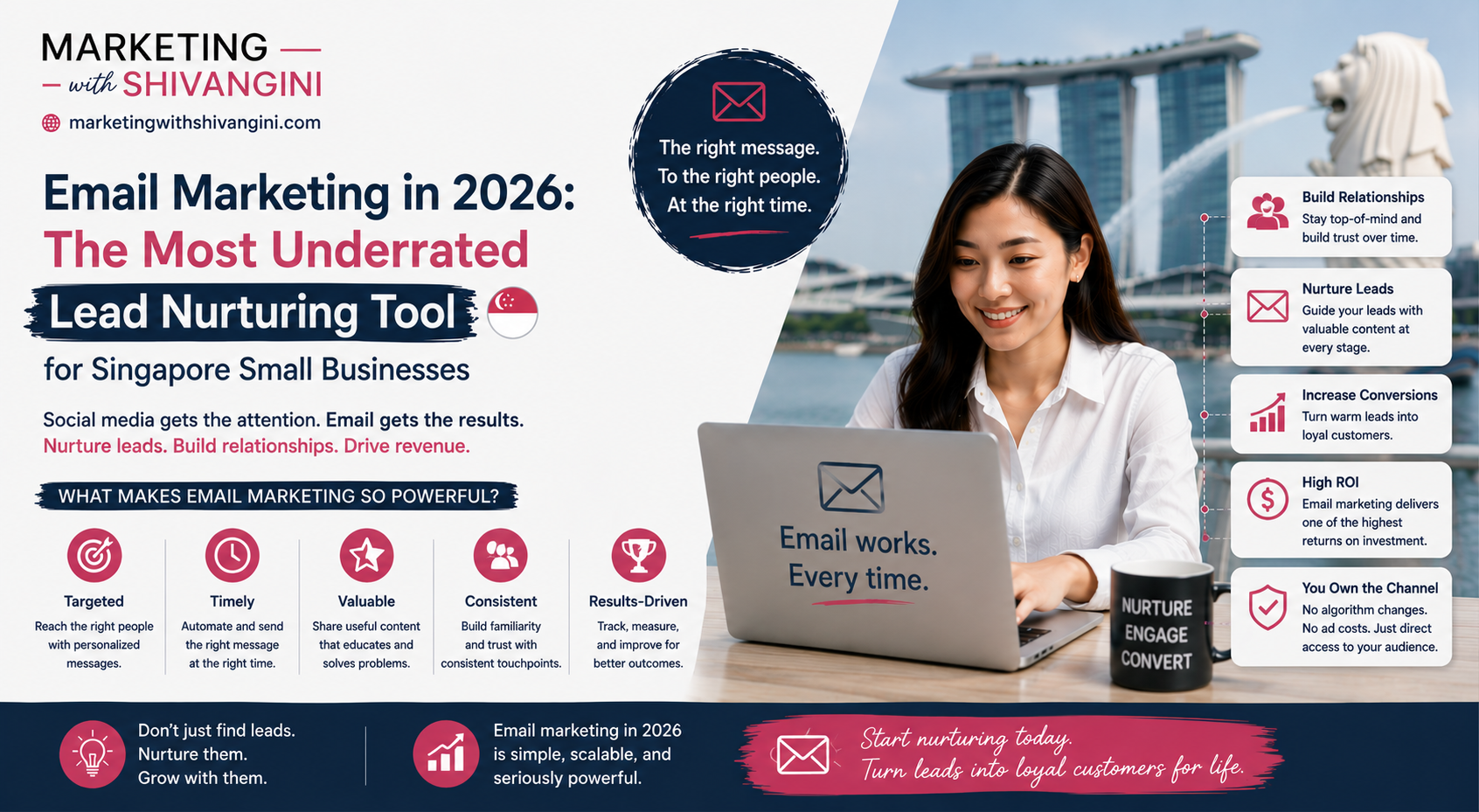
Email Marketing in 2026: The Most Underrated Lead Nurturing Tool for Singapore Small Businesses
In a world dominated by social media algorithms and rising ad costs, email remains one of the most reliable and cost-effective marketing channels available. The average email marketing ROI sits around 36 to 40 dollars for every dollar spent globally — a figure that consistently outperforms most paid digital channels.
Yet most small businesses in Singapore are not doing it. And of those that are, the majority are doing it incorrectly.
Here is what email marketing looks like when it actually works.
Why Email Works When Social Does Not Always Deliver
When someone gives you their email address, they are giving you direct access — no algorithm between you and them. An email lands in their inbox. A social post competes with hundreds of others for a few seconds of attention. The relationship is fundamentally different, and so is the level of trust it can build over time.
For service-based businesses — clinics, law firms, financial advisers, consultants, contractors — email is one of the most effective ways to stay top of mind with potential clients who are not ready to hire you today but will be in three, six, or twelve months. The business that has been sending them genuinely useful emails during that waiting period will be the first call they make.
What to Send
The single biggest mistake is sending emails only when you want something — a promotion, a special offer, a holiday greeting. Clients switch off fast.
A far more effective approach is the 80/20 rule: 80 percent of your emails should give value — tips, insights, answers to common questions, helpful resources. Twenty percent can be promotional. This ratio builds trust, reduces unsubscribes, and makes your promotional emails far more effective when they do arrive.
Ideas for genuinely useful emails for Singapore small businesses:
A physio clinic might send a short monthly email on managing common conditions at home. A lawyer might send updates on regulatory changes relevant to their client base. An interior designer might share a “before and after” with lessons learned. A digital marketing consultant might share one practical tip per week that clients can implement themselves.
The Technical Setup That Matters
Use a proper email marketing platform — Mailchimp, ActiveCampaign, or Klaviyo are the most widely used — rather than sending from a personal Gmail account. Platforms give you open rate data, click tracking, segmentation, and automation, all of which matter if you want to improve over time.
Segment your list. Prospects need different emails than existing clients. New subscribers need a different onboarding sequence than long-term contacts. Even basic segmentation will significantly improve your results.
Comply with Singapore’s Personal Data Protection Act (PDPA). Only email people who have explicitly opted in. Always include an unsubscribe option. This is not just legal compliance — it is what builds a quality list of people who actually want to hear from you.
Starting Simply
If you have never done email marketing before, start with this: collect email addresses at every client touchpoint, load them into a free Mailchimp account, and commit to sending one genuinely useful email per month. That is enough to start building a habit, a list, and a relationship.
[We design and manage email marketing campaigns for Singapore small businesses. Learn more.
Frequently Asked Questions
Q: Is email marketing still effective for small businesses in Singapore in 2026?
Yes. Email marketing consistently delivers one of the highest returns of any digital channel — approximately SGD 36 to 40 for every SGD 1 spent globally. Unlike social media, email gives you direct access to your audience without algorithmic interference. For service businesses with a longer sales cycle — consultants, lawyers, healthcare providers, financial advisers — email is particularly effective for staying top of mind with prospects who are not ready to buy immediately.
Q: What email marketing platform should a Singapore small business use?
Mailchimp is the most widely used starting point — it has a free tier suitable for lists under 500 contacts and is straightforward to set up. ActiveCampaign is a strong choice for businesses that want automation and CRM features. Klaviyo is preferred for e-commerce businesses. All three comply with PDPA requirements when configured correctly. Avoid sending marketing emails from personal Gmail or Outlook accounts — you will not have tracking, segmentation, or opt-out management.
Q: What does PDPA mean for email marketing in Singapore?
Singapore’s Personal Data Protection Act (PDPA) requires that businesses only send marketing emails to people who have explicitly opted in to receive communications from them. You must provide a clear unsubscribe option in every email and honour opt-out requests promptly. Purchased email lists are generally non-compliant. Building your list organically — through website forms, events, and client onboarding — is both the legal approach and the most effective one, as opted-in subscribers are significantly more likely to engage and convert.
Q: What should a small business actually send in its email newsletter?
Follow the 80/20 rule: 80 percent of your emails should provide genuine value — useful tips, client stories, answers to common questions, relevant industry updates. Twenty percent can be promotional — offers, service announcements, or calls to book. Emails that only ever sell quickly accumulate unsubscribes. Emails that consistently deliver useful information build trust, reduce churn, and make promotional emails far more effective when they arrive.