



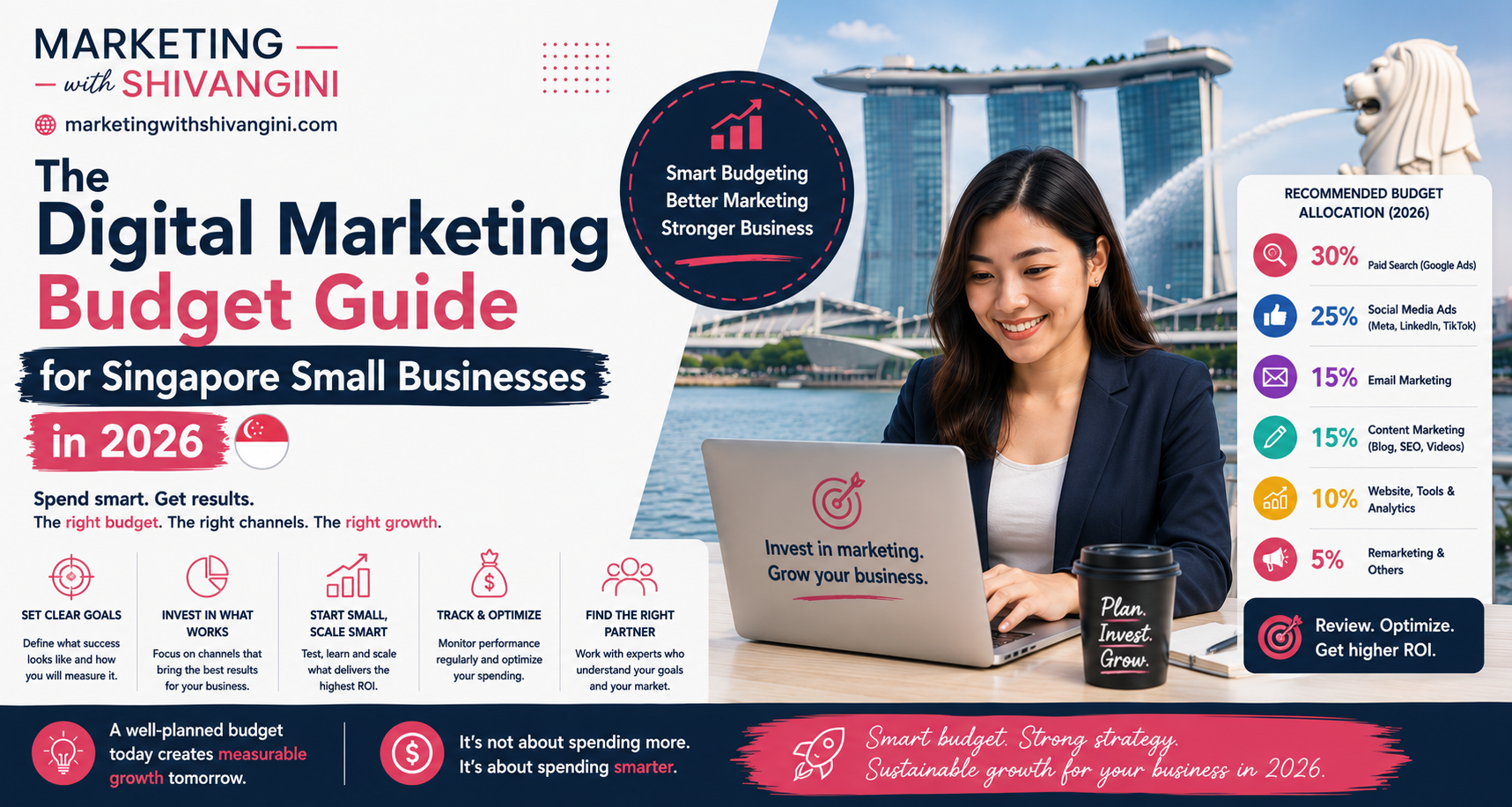
The Digital Marketing Budget Guide for Singapore Small Businesses in 2026
One of the most common questions I get from small business owners in Singapore is: “How much should I be spending on digital marketing?” It is also one of the most difficult to answer without context — because the right number depends heavily on your industry, your growth goals, your current digital footprint, and what you are trying to achieve.
But there are frameworks that work, and benchmarks that are useful, and a way to think about this that most agencies will not walk you through because they have an incentive to make it seem more complex than it is.
Here is the honest version.
The Rule of Thumb
Most marketing advisers and industry bodies suggest that small businesses should allocate 7 to 10 percent of gross revenue to marketing, with digital accounting for the majority of that in 2026. For a business generating SGD 500,000 per year, that is SGD 35,000 to 50,000 — or roughly SGD 3,000 to 4,200 per month.
In practice, many Singapore SMEs spend significantly less — sometimes SGD 1,000 to 2,000 per month — and wonder why growth is slow. Others spend more but without a clear strategy, which produces equally frustrating results.
The number matters less than the allocation.
How to Allocate a SGD 3,000/Month Marketing Budget
Website maintenance and SEO (SGD 800–1,000): This is infrastructure. A well-maintained, SEO-optimised website is the foundation everything else relies on. Cutting this creates a ceiling on everything else you do.
Paid media — Meta and/or Google Ads (SGD 1,000–1,500): This is the engine for new lead generation, especially in the early stages when organic channels have not yet built momentum. Split between platforms based on where your customers actually spend time.
Content creation — blogs, social media, email (SGD 500–800): This is the long game. Content compounds over time and reduces your dependence on paid media. Invest in at least two to four quality blog posts per month and a consistent social media presence.
Analytics and tools (SGD 200–300): Google Analytics 4 is free. Email marketing tools start at zero. Some CRM tools have free tiers. Invest in the tools that give you data, not vanity metrics.
What to Expect in Return
In a competitive Singapore market, a well-run digital marketing programme with a budget of SGD 2,000 to 4,000 per month should generate a measurable increase in qualified leads within three to six months. The first month is almost always the worst — it is when the campaign is learning and the strategy is being refined. Cutting campaigns before they have had time to produce data is one of the most expensive mistakes a small business can make.
Track your cost per lead. Track your lead-to-client conversion rate. Calculate your client lifetime value. These three numbers will tell you exactly whether your marketing spend is working.
When to Increase Your Budget
When a channel is producing leads at a profitable cost per acquisition, increase the budget. When you cannot grow revenue because you do not have enough leads, increase the marketing budget before you hire more staff. Marketing spend that generates clients is not a cost — it is an investment with a calculable return.
Frequently Asked Questions
Q: How much should a small business in Singapore spend on digital marketing in 2026?
The general benchmark is 7 to 10 percent of gross revenue, with digital accounting for the majority of that in 2026. For a business generating SGD 500,000 annually, this translates to roughly SGD 3,000 to 4,200 per month. Businesses in early growth stages or highly competitive industries may need to invest more to build momentum. The allocation across channels — SEO, paid ads, content, email — matters as much as the total number.
Q: What is the best way to allocate a SGD 2,000 per month digital marketing budget for a Singapore small business?
A practical allocation: SGD 600 to 800 on website SEO and maintenance, SGD 700 to 900 on paid media (Meta and/or Google Ads), SGD 300 to 500 on content creation (blogs, social), and SGD 100 to 200 on tools such as email marketing software and analytics. This covers your digital foundations while maintaining both immediate lead generation through paid media and long-term organic growth through content and SEO.
Q: How do I know if my digital marketing spend is producing a return?
Track three numbers: cost per lead (total spend divided by number of qualified enquiries), lead-to-client conversion rate (percentage of leads who become paying clients), and client lifetime value (average revenue per client over the relationship). These three metrics tell you whether your marketing spend is generating profitable growth or just activity. If your cost per lead is lower than your client value divided by conversion rate, your marketing is working.
Q: When should a Singapore small business increase its marketing budget?
Increase your budget when a channel is producing leads at a profitable cost per acquisition and you want to scale results. Also increase it when your primary constraint to growth is a lack of leads rather than a lack of capacity. Marketing spend that reliably generates clients is an investment, not a cost — the return can be calculated and the budget sized accordingly. Cutting marketing budget during slow periods is one of the most common and costly mistakes small businesses make.


